Jarrod Wetzel-Brown
Title
Jarrod Wetzel-Brown
Description
The Prudential Center: Spatial Consumerism
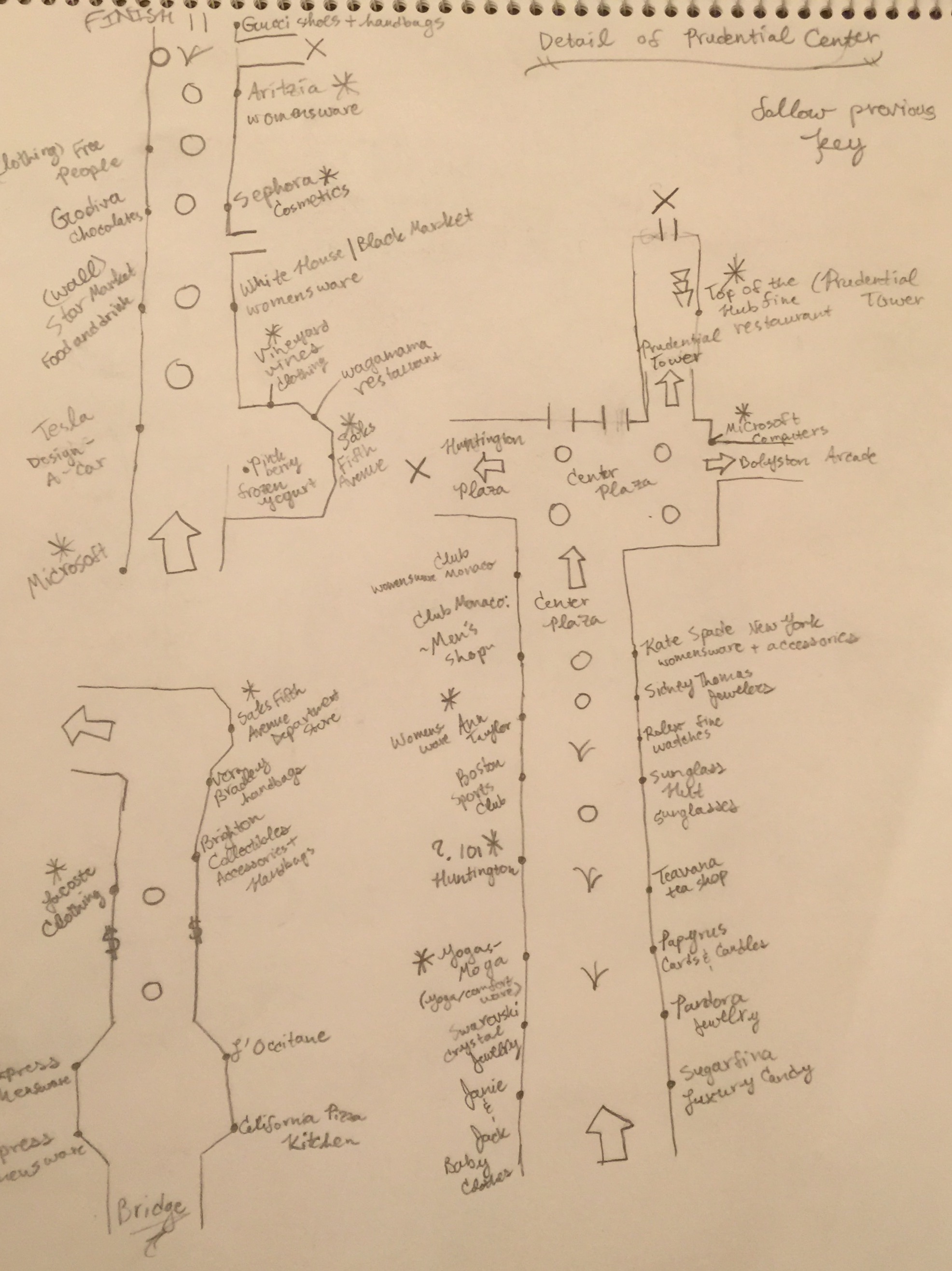
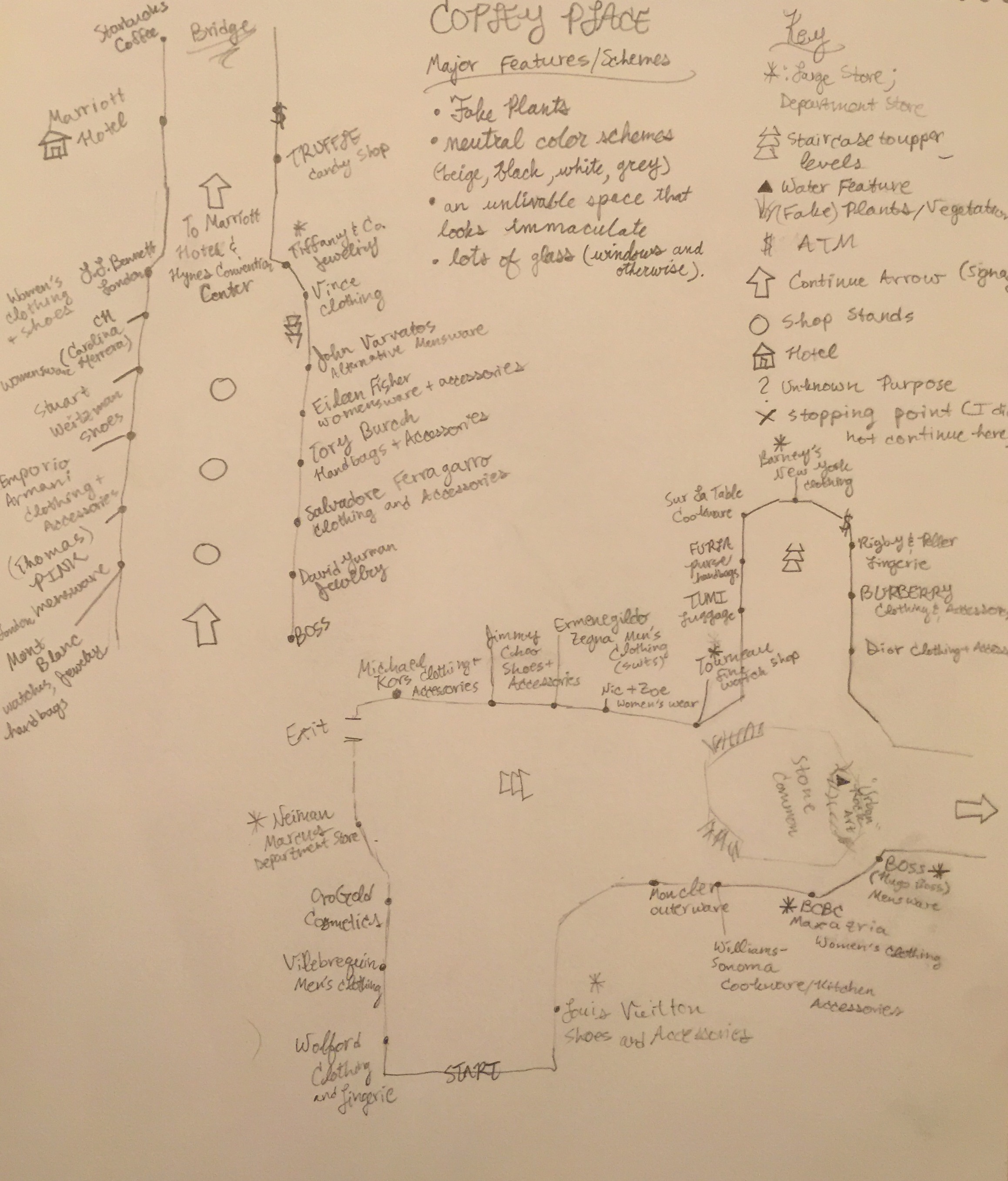
I must admit that I was struck by how similar everything was in the Prudential Center/Copley Place. I understand that shopping malls are meant to be a cohesive conglomerate of boutiques, but, when walking around, I could not believe that the ceilings, walls, shop monikers, and even the shops themselves mimicked each other. The color scheme of these individual features was very limited and included beige wood features, crème-colored walls, and white and black store fronts and details. Even the wall sconces and light fixtures were the same colors. I did notice that the stores themselves had white fluorescent lighting, but the mall’s public spaces emitted a soft yellow light from what seemed to be incandescent lightbulbs. This intrigued me and aged the space for me substantially. It also made the space a bit warmer than the harsh lighting inside of the stores.
The elevation of the store remained surprisingly constant other than when escalators and elevators were inserted for traveling to other levels. Glass was a major part of the program’s design which makes sense since stores want patrons to see their products. The outside of the building itself also utilized this “reveal” effect. You can see some of the stores and customers from across the street thanks to having a substantial part of the building consist of glass. Harsh lines and geometric patterns both on the outside of the building and within create sharp contrasts that add to the distinct separation of each store and individual departments.
I observed people talking, walking, sitting on benches, eating, and, surprisingly, very few people were holding shopping bags. If anything, I was surprised to see how many people just seemed to be walking through the mall for fun. In terms of security, there were guards present near all of the entrances and even inside a few stores (four of them questioned me about what I was doing with a sketchbook). The walkways were relatively spacious and high ceilings gave the illusion of even more open spaces. I did not feel like anyone was particularly excluded by the building’s design, but, if physically handicapped, some of the stores were more accommodating than others in terms of entrance and aisle width.
There was only one major meeting space which was similar to an indoor courtyard. The space reminded me of the gardens we have been discussing in class, but the fake places and placid water feature felt out of place.
Lastly, I was really intrigued by how carefully planned out the stores were. For every men’s clothing store, there was a women’s clothing store either next door or across the aisle. Every watch shop was located next to another accessory shop or jewelry shop, and even shoe shops were placed next to one another.
Newbury Street: Open Air and Fresh Perspective
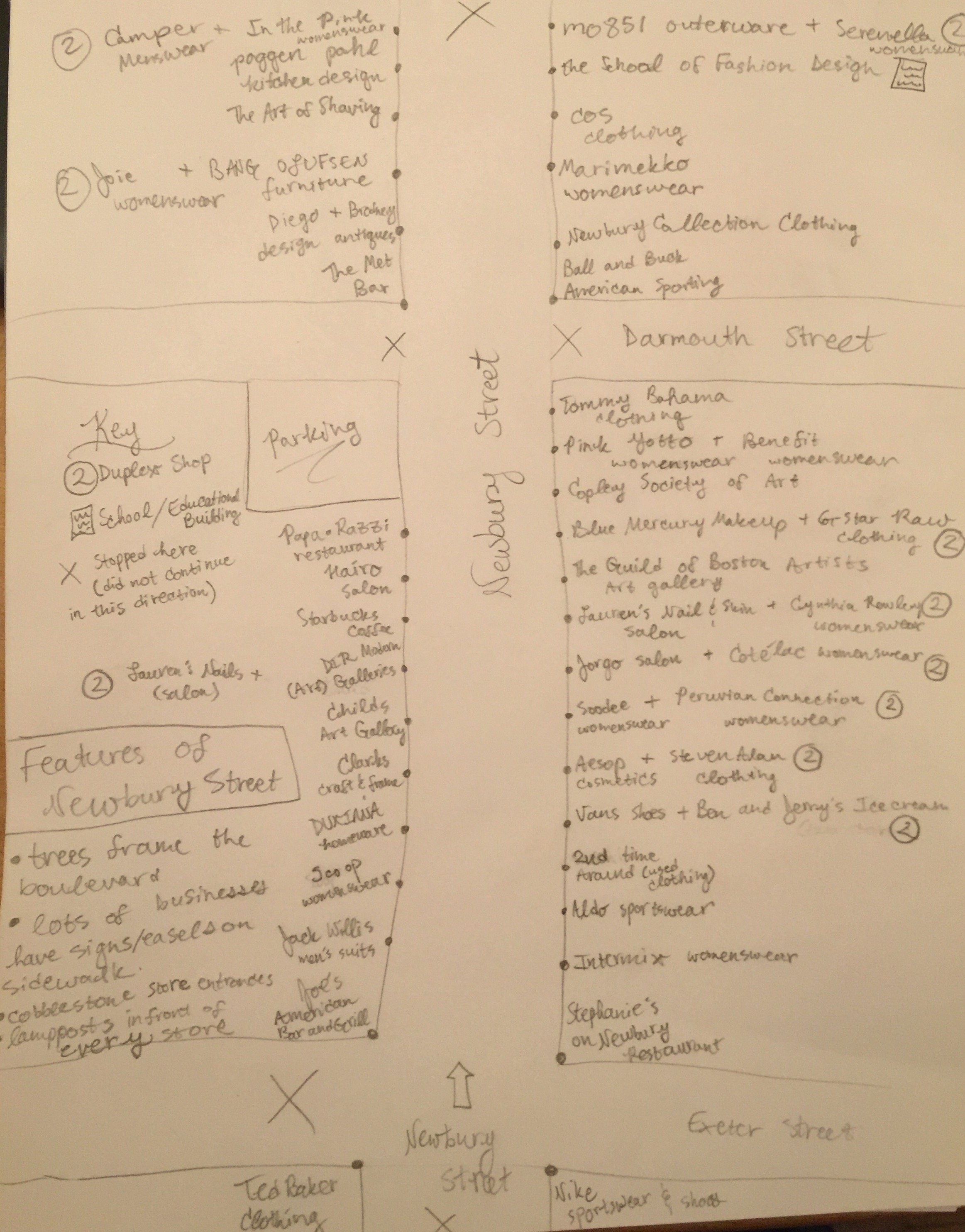
Newbury Street is cluttered with shops and restaurants which all have massive monikers. Some were lit up, others had bright, painted letters, and anyone can see from meters away that the street possesses many stores to explore. On the street, I also saw lots of standing easels that had bright text that read “SALE!” Many of the buildings were duplexes with two shops that were literally stacked up on one another. I was very surprised by the contrast between Newbury Street’s setup versus the Prudential Center’s layout. Unlike the carefully planned out store schemes of the Center, Newbury Street’s shops were not really separated by the programs they housed. I saw a sportswear store ironically placed above an ice cream parlor, a used clothing store rested beneath a designer suit shop, and many other contrasting company tenants were around where space was available.
I will say that the straight path of the street is actually really conveynient for consumers to see many stores at once. Unlike the Prudential Center, people can find all of the stores on one straight street which is wonderful. However, the street does remain different from the hallways of the shopping mall because it is separated by a busy street which makes it hard for people to cross, except at intersections, and so some of the stores are a bit more difficult to reach.
The entrances and exits of the shops consist of two design schemes. The upper level shops possess large stone steps and rather ornate doorways (that preserve the architecture of the area). The lower-level shops have cobblestone entrances that are obviously separate from the smooth sidewalk. Smaller steps leading down to the store’s doors are also present. Unlike the mall, there are no wheelchair accessible entrances to any of the shops which is discouraging.
As mentioned above, the shops use easels with sales taglines and large monikers that mimic the shopping mall storefronts. I will say that the stores seem much more independent because they are in separate buildings on a metropolitan street rather than all squeezed inside of one large building. Personally, the presence of real trees and simply designed lampposts also made the atmosphere more welcoming to me as a consumer, and I really appreciated the openness of the street. I did not feel crowded in that open space but felt a little crowded inside of the mall.
I must admit that I was struck by how similar everything was in the Prudential Center/Copley Place. I understand that shopping malls are meant to be a cohesive conglomerate of boutiques, but, when walking around, I could not believe that the ceilings, walls, shop monikers, and even the shops themselves mimicked each other. The color scheme of these individual features was very limited and included beige wood features, crème-colored walls, and white and black store fronts and details. Even the wall sconces and light fixtures were the same colors. I did notice that the stores themselves had white fluorescent lighting, but the mall’s public spaces emitted a soft yellow light from what seemed to be incandescent lightbulbs. This intrigued me and aged the space for me substantially. It also made the space a bit warmer than the harsh lighting inside of the stores.
The elevation of the store remained surprisingly constant other than when escalators and elevators were inserted for traveling to other levels. Glass was a major part of the program’s design which makes sense since stores want patrons to see their products. The outside of the building itself also utilized this “reveal” effect. You can see some of the stores and customers from across the street thanks to having a substantial part of the building consist of glass. Harsh lines and geometric patterns both on the outside of the building and within create sharp contrasts that add to the distinct separation of each store and individual departments.
I observed people talking, walking, sitting on benches, eating, and, surprisingly, very few people were holding shopping bags. If anything, I was surprised to see how many people just seemed to be walking through the mall for fun. In terms of security, there were guards present near all of the entrances and even inside a few stores (four of them questioned me about what I was doing with a sketchbook). The walkways were relatively spacious and high ceilings gave the illusion of even more open spaces. I did not feel like anyone was particularly excluded by the building’s design, but, if physically handicapped, some of the stores were more accommodating than others in terms of entrance and aisle width.
There was only one major meeting space which was similar to an indoor courtyard. The space reminded me of the gardens we have been discussing in class, but the fake places and placid water feature felt out of place.
Lastly, I was really intrigued by how carefully planned out the stores were. For every men’s clothing store, there was a women’s clothing store either next door or across the aisle. Every watch shop was located next to another accessory shop or jewelry shop, and even shoe shops were placed next to one another.
Newbury Street: Open Air and Fresh Perspective
Newbury Street is cluttered with shops and restaurants which all have massive monikers. Some were lit up, others had bright, painted letters, and anyone can see from meters away that the street possesses many stores to explore. On the street, I also saw lots of standing easels that had bright text that read “SALE!” Many of the buildings were duplexes with two shops that were literally stacked up on one another. I was very surprised by the contrast between Newbury Street’s setup versus the Prudential Center’s layout. Unlike the carefully planned out store schemes of the Center, Newbury Street’s shops were not really separated by the programs they housed. I saw a sportswear store ironically placed above an ice cream parlor, a used clothing store rested beneath a designer suit shop, and many other contrasting company tenants were around where space was available.
I will say that the straight path of the street is actually really conveynient for consumers to see many stores at once. Unlike the Prudential Center, people can find all of the stores on one straight street which is wonderful. However, the street does remain different from the hallways of the shopping mall because it is separated by a busy street which makes it hard for people to cross, except at intersections, and so some of the stores are a bit more difficult to reach.
The entrances and exits of the shops consist of two design schemes. The upper level shops possess large stone steps and rather ornate doorways (that preserve the architecture of the area). The lower-level shops have cobblestone entrances that are obviously separate from the smooth sidewalk. Smaller steps leading down to the store’s doors are also present. Unlike the mall, there are no wheelchair accessible entrances to any of the shops which is discouraging.
As mentioned above, the shops use easels with sales taglines and large monikers that mimic the shopping mall storefronts. I will say that the stores seem much more independent because they are in separate buildings on a metropolitan street rather than all squeezed inside of one large building. Personally, the presence of real trees and simply designed lampposts also made the atmosphere more welcoming to me as a consumer, and I really appreciated the openness of the street. I did not feel crowded in that open space but felt a little crowded inside of the mall.
Files
Collection
Citation
“Jarrod Wetzel-Brown,” US-WORLD 29, accessed October 20, 2026, https://usworld29.omeka.fas.harvard.edu/items/show/160.