Oriana Wang
Title
Oriana Wang
Description
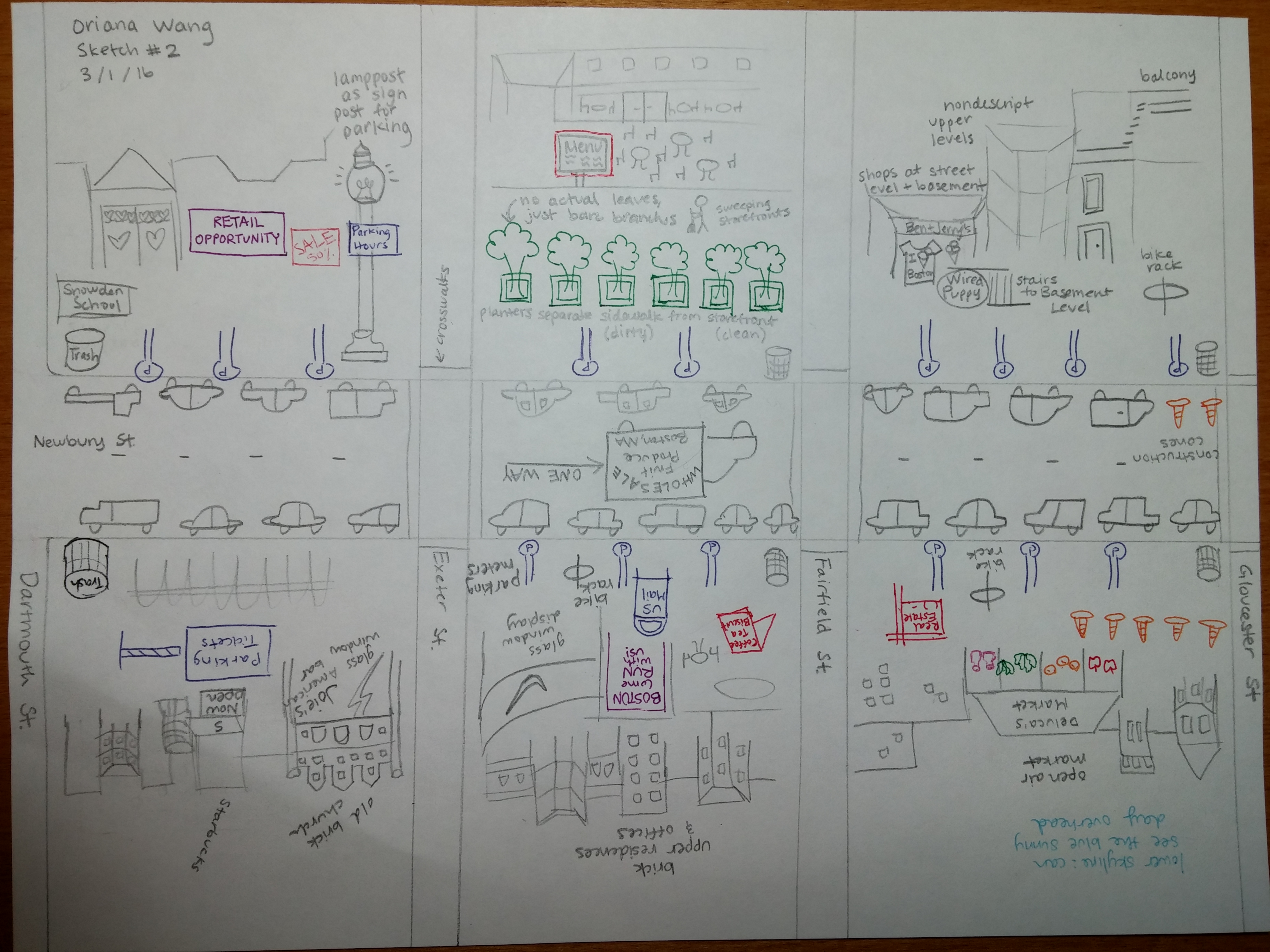
To sketch Copley Place/Prudential Center Malls and Newbury St., I first stopped by Newbury St. since it was earlier in the morning and the shops at the mall were not open yet. At Newbury St., it was extremely easy to navigate to, just one block away from the Copley T Stop. The shops along Newbury St were renting out of larger buildings, the 2nd, 3rd, and 4th floor of which were being used for residences or offices and were rather nondescript. However, the street level and basement level were much more aesthetic, with pretty shop windows, outdoor tables and seating, and the promise of finding something unique and wonderful. The modern glass storefronts were contrasted with the old brick buildings and the narrow one-way street, which at 8am was already left with no free parking spots. Parking meters, bike racks, and wide sidewalks allowed the normal heavy foot traffic during the busy times to influx into this elongated shopping area. Planters separated sidewalks from store fronts, basements were finished and sometimes housed fancy restaurants, and trash cans lined the streets. There were signs for sales, for real estate properties, for streets, and for city events, all to attract customers to individual stores, which seemed to be competing with one another for your attention. Although filled with its fair share of luxury stores, Newbury St. still seemed grounded as it had to face traffic and parking issues, inconsistent weather, city dwellers by the masses, and the unpredictable inevitability of change as stores would pop up or go out of business.
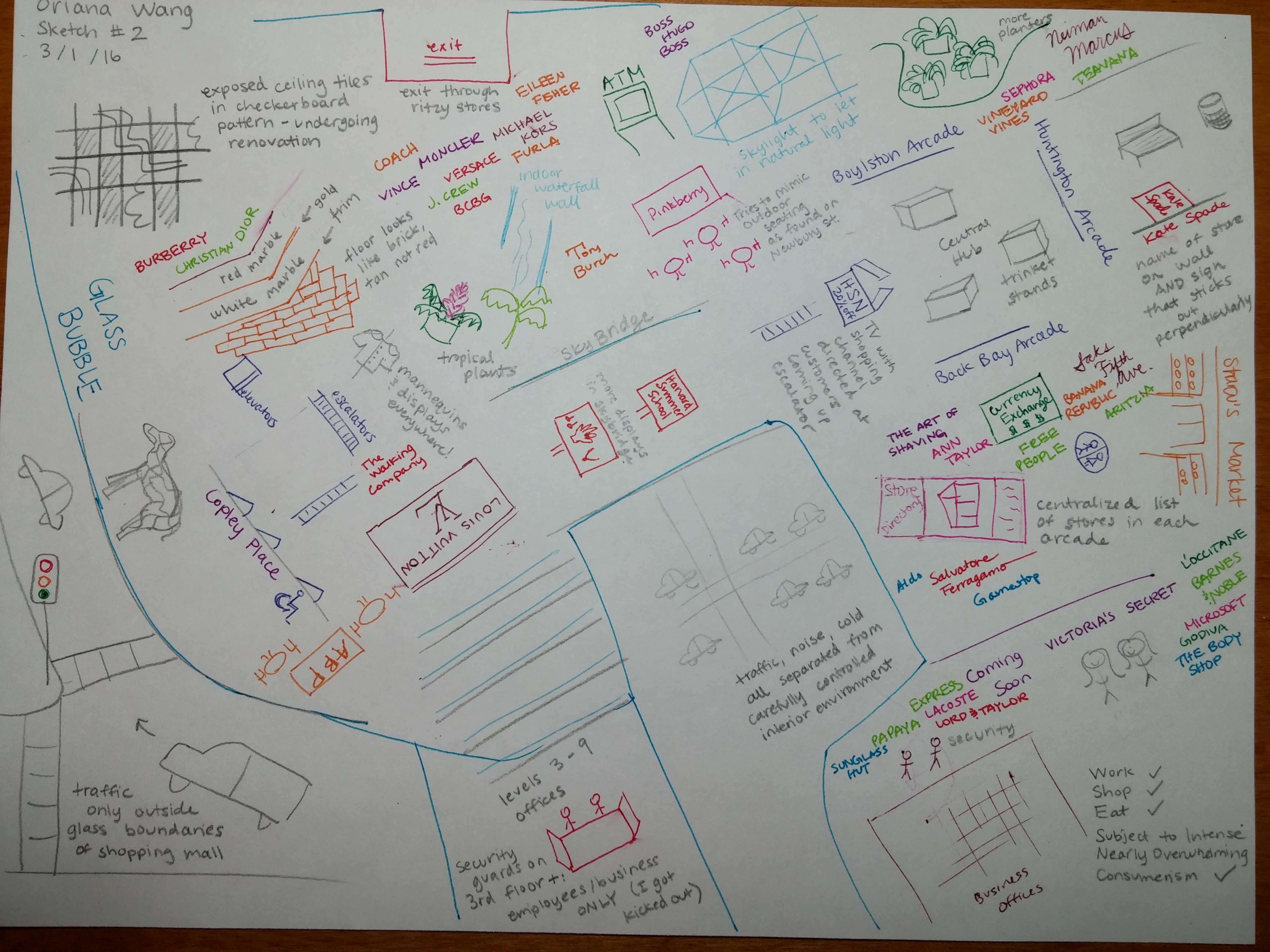
However, when I walked to Copley Place, the busy yet mundane daily car traffic of the streets gave way to an overload of consumerism as I entered the glass doors through the handicapped non-revolving entrance (which had been propped open). It was much more modern, and far more self-contained, as if you had stepped into a glass capsule. Inviting at first due to the chilly air outside, I soon realized it all felt too perfectly controlled. Centralized store directories coordinated with signs everywhere to direct shoppers. Though necessary and convenient, they were all directed towards making it easier and more enjoyable to spend your money. Colors, logos, marble, gold trim, and luxury abounded at Copley Place. Through the skybridge, you could see an advertisement for Harvard Summer School while peering down at the traffic of the city and the honking. Then you could look up to see the other skyscrapers, impenetrable to the gaze with their reflective glass exteriors (to be fair, I am a fan of the modern glass aesthetic in large part, but it was odd and counterintuitive to be in one glass building looking out the crystal clear windows and unable to visually enter another skyscraper made of the same material).
Prudential Center was similar, although slightly geared towards the middle class consumer as opposed to the luxury consumer. Advertisements were everywhere, marked exits were through department stores, benches provided some minimal seating in the center aisles, and it was easy to get lost in the maze of stores. I had a far harder time navigating my way around the mall trying to sketch. Linearity was broken. As for security, I was stopped and turned away at the 3rd floor of Copley Place, the boundary between shops and businesses. I was also questioned by a security guard as I stopped to write in a notebook and take pictures of some store fronts. Yet at Newbury St., I felt free to roam as I pleased, finding a welcoming city neighborhood as opposed to a patronizing conglomerate mall. Interestingly enough, I had never been so opposed to indoor shopping malls, and their design and implementation, until I was forced to take notice of everything through sketching. I will praise their convenience and centrality, but would much rather stroll along a street with charm and character.
However, when I walked to Copley Place, the busy yet mundane daily car traffic of the streets gave way to an overload of consumerism as I entered the glass doors through the handicapped non-revolving entrance (which had been propped open). It was much more modern, and far more self-contained, as if you had stepped into a glass capsule. Inviting at first due to the chilly air outside, I soon realized it all felt too perfectly controlled. Centralized store directories coordinated with signs everywhere to direct shoppers. Though necessary and convenient, they were all directed towards making it easier and more enjoyable to spend your money. Colors, logos, marble, gold trim, and luxury abounded at Copley Place. Through the skybridge, you could see an advertisement for Harvard Summer School while peering down at the traffic of the city and the honking. Then you could look up to see the other skyscrapers, impenetrable to the gaze with their reflective glass exteriors (to be fair, I am a fan of the modern glass aesthetic in large part, but it was odd and counterintuitive to be in one glass building looking out the crystal clear windows and unable to visually enter another skyscraper made of the same material).
Prudential Center was similar, although slightly geared towards the middle class consumer as opposed to the luxury consumer. Advertisements were everywhere, marked exits were through department stores, benches provided some minimal seating in the center aisles, and it was easy to get lost in the maze of stores. I had a far harder time navigating my way around the mall trying to sketch. Linearity was broken. As for security, I was stopped and turned away at the 3rd floor of Copley Place, the boundary between shops and businesses. I was also questioned by a security guard as I stopped to write in a notebook and take pictures of some store fronts. Yet at Newbury St., I felt free to roam as I pleased, finding a welcoming city neighborhood as opposed to a patronizing conglomerate mall. Interestingly enough, I had never been so opposed to indoor shopping malls, and their design and implementation, until I was forced to take notice of everything through sketching. I will praise their convenience and centrality, but would much rather stroll along a street with charm and character.
Files
Collection
Citation
“Oriana Wang,” US-WORLD 29, accessed October 20, 2026, https://usworld29.omeka.fas.harvard.edu/items/show/159.