Eliza Decubellis
Title
Eliza Decubellis
Description
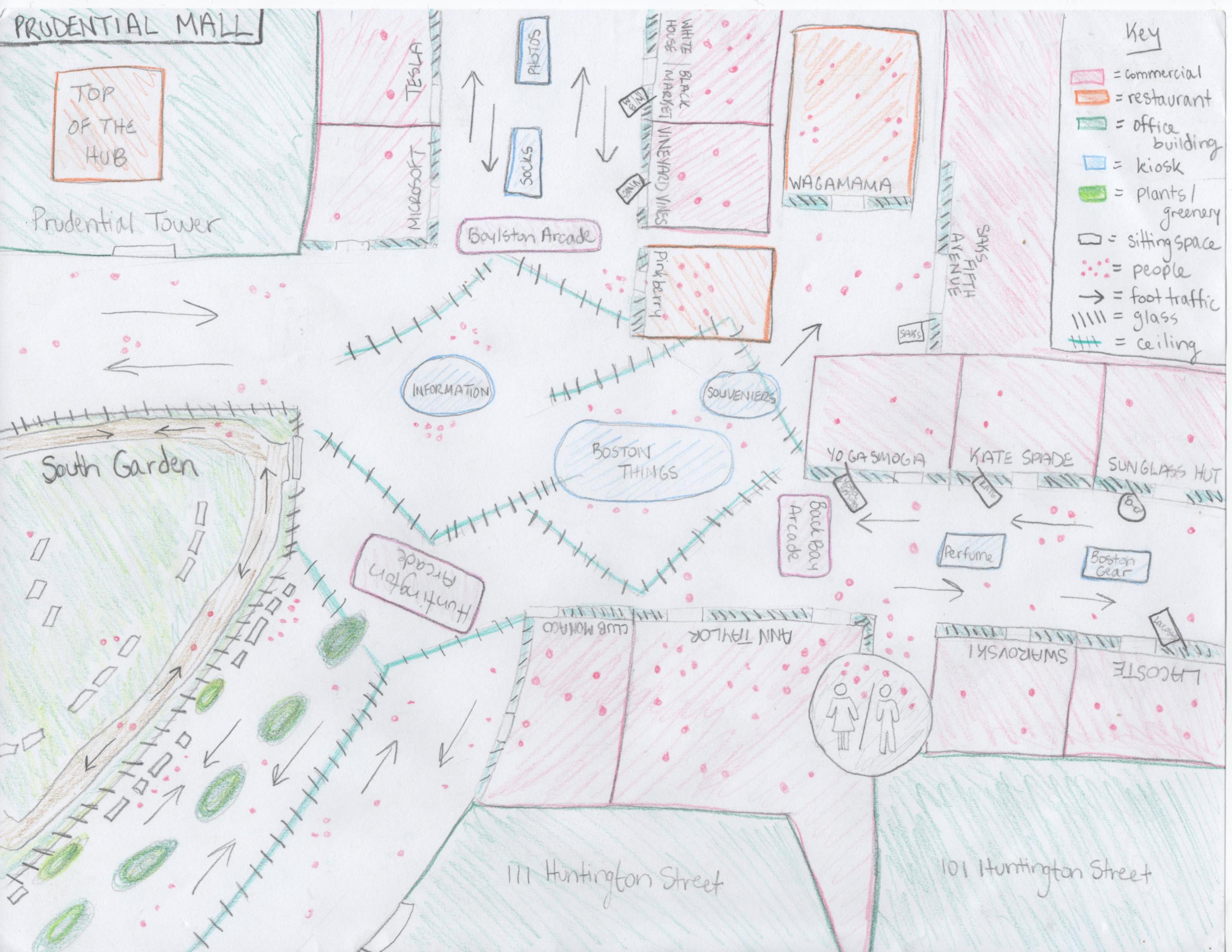
Examining these two different commercial spaces was very interesting because it became evident how they were trying to imitate one another, but also how different they still were. To start, I went to the Prudential/Copley Malls, and I noticed that the use of glass both in storefronts and in the walls and ceilings was very prominent. This creates a fluid feel between indoors and outdoors to make the shoppers feel like they are in a more natural and less commercial, man-made space. The use of plants and large greenery in certain spaces also helps to achieve this natural feel, as does a large outdoor garden that can be clearly seen right outside the mall through large glass walls. The smaller signs hanging off many of the storefronts (which I tried to portray in my sketch) also give the feeling of walking down an outdoor street with small boutiques all in a row. The high, uneven, glass ceilings are also artfully constructed to blend in with the natural sky and give a very open feeling. The people in the space seem to mainly be there to shop and spend money in some way, whether that is in shops or in restaurants, but there are also a few gathering spaces with seating near the foliage and large windows. The entrances and exits to the mall are very streamlined because they are only in a few, designated spots, so it seems to attract people who are coming in with a purpose (and with money to spend).
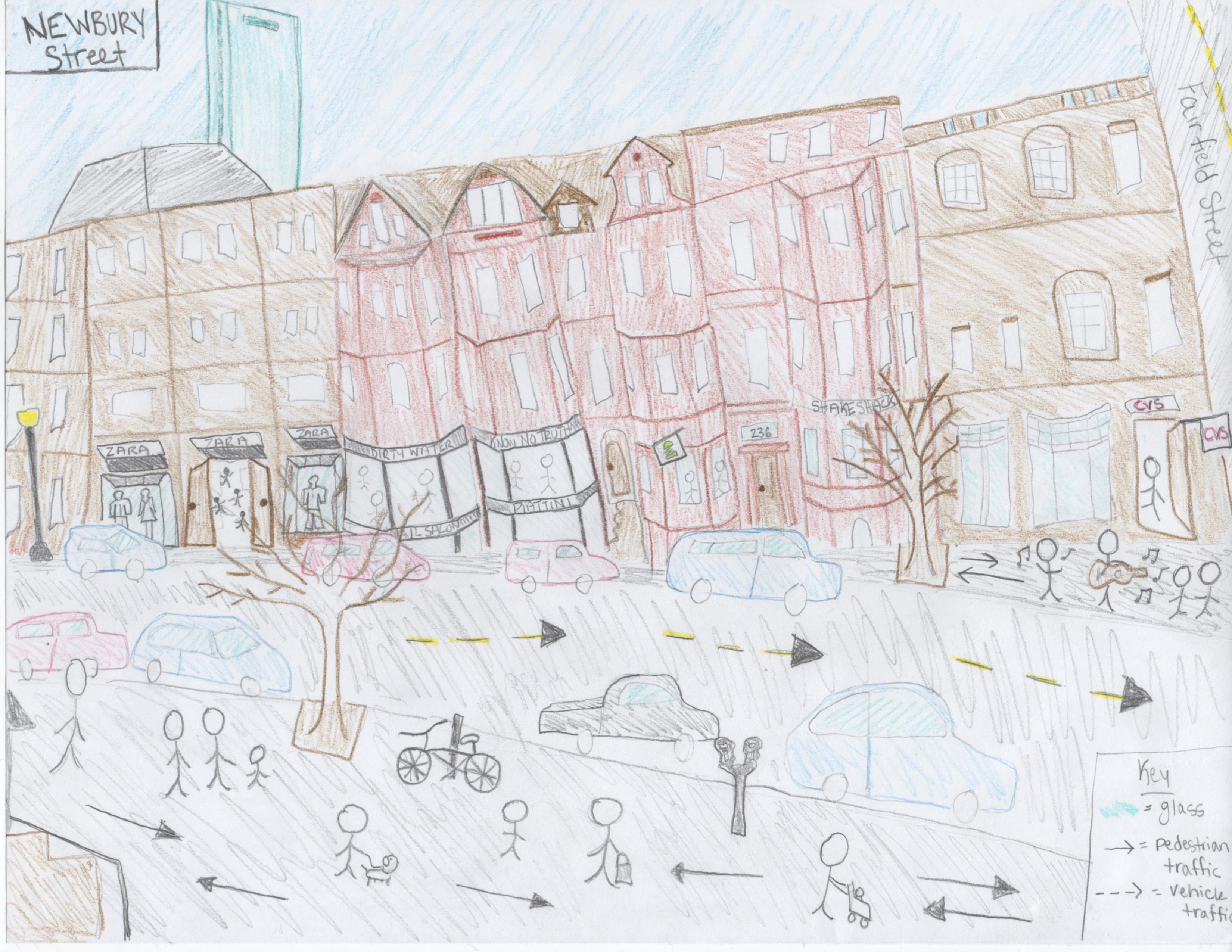
I then went Newbury Street and sat across from Shake Shack (between Fairfield and Exeter Streets) to observe that space. The commercial aspects of the space are comparable to the indoor mall because all of the stores are very close together, and they utilize the same large, glass storefronts to display goods and small signs hanging off the buildings with the store names. However, the interesting thing about Newbury Street is that it is very clearly a space used for activities other than commerce as well, so people just out walking with dogs or kids or friends are integrated with shoppers. The entrances and exits to the streets also reflect this inclusivity because they are much more decentralized than they are in the mall – you can enter and exit from many different side streets – so anyone, even those who are just passing through without any intention to spend money, can experience the space. There are also people hanging out and doing things they love like playing music on the street, which is actually in an attempt to make money rather than spend it. The obvious presence of cars and the sounds that accompany them also point out how different this space is from a mall and how much more integrated it is into the urban fabric, which differs from the man-made, disruptive indoor mall.
I then went Newbury Street and sat across from Shake Shack (between Fairfield and Exeter Streets) to observe that space. The commercial aspects of the space are comparable to the indoor mall because all of the stores are very close together, and they utilize the same large, glass storefronts to display goods and small signs hanging off the buildings with the store names. However, the interesting thing about Newbury Street is that it is very clearly a space used for activities other than commerce as well, so people just out walking with dogs or kids or friends are integrated with shoppers. The entrances and exits to the streets also reflect this inclusivity because they are much more decentralized than they are in the mall – you can enter and exit from many different side streets – so anyone, even those who are just passing through without any intention to spend money, can experience the space. There are also people hanging out and doing things they love like playing music on the street, which is actually in an attempt to make money rather than spend it. The obvious presence of cars and the sounds that accompany them also point out how different this space is from a mall and how much more integrated it is into the urban fabric, which differs from the man-made, disruptive indoor mall.
Files
Collection
Citation
“Eliza Decubellis,” US-WORLD 29, accessed October 19, 2026, https://usworld29.omeka.fas.harvard.edu/items/show/105.