Lucas Cuatrecasas
Title
Lucas Cuatrecasas
Description
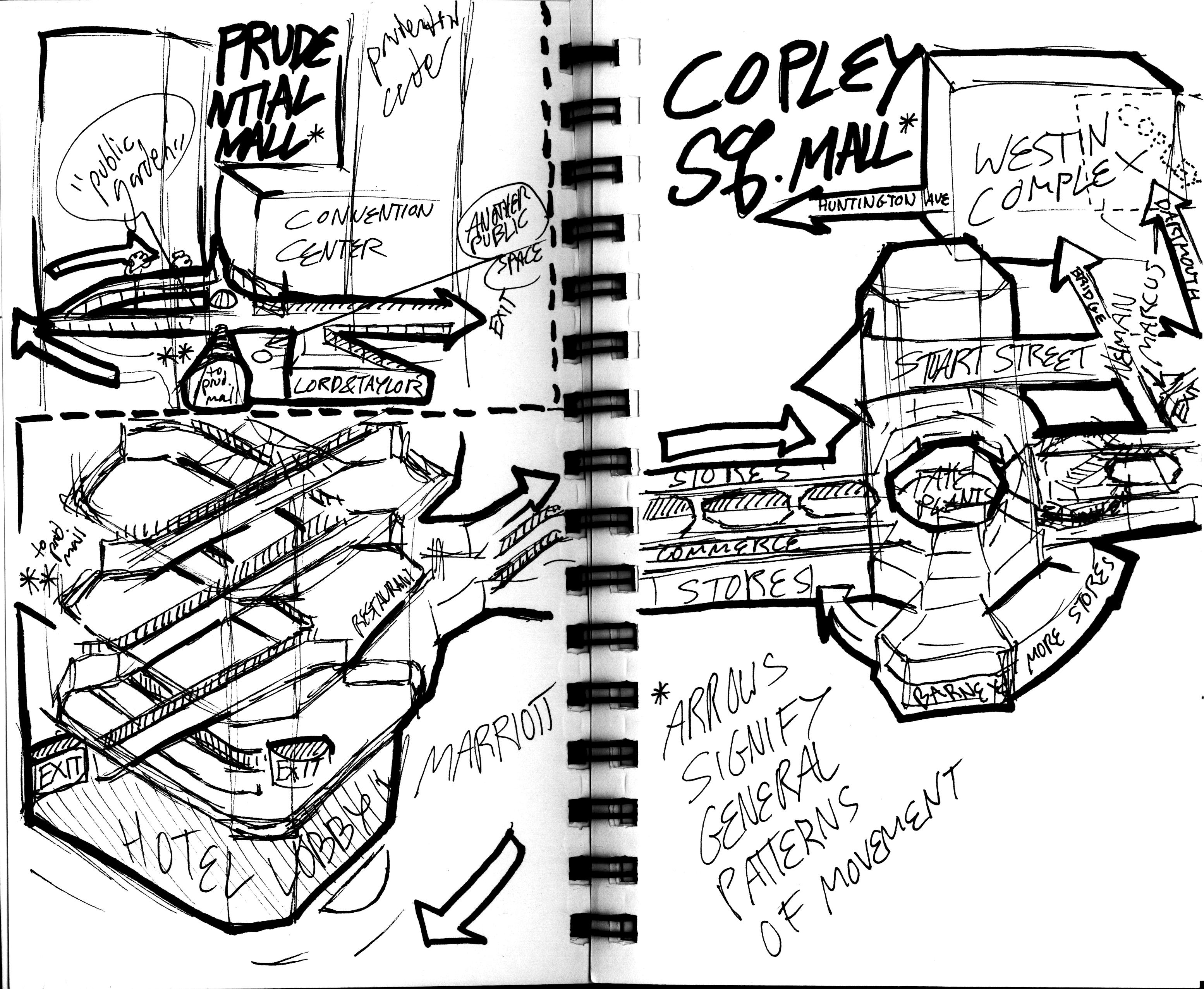
I'll admit that I thought what I was going to learn from this assignment was that street-level commerce produces a convivial, integrated atmosphere whereas enclosed galleries make for predictable, contrived shopping—an opposition implying that wholly privatized space isn't fun unless you're buying something. And while the palpable differences between Newbury Street and the Prudential/Copley mall complex do confirm this bias of mine, the reality is a bit more complicated. First, as I've tried to indicate by using arrows in my sketch, both portions of the mall are surprisingly well-designed, allowing for a seamless passage from the street to the galleries, from the galleries into skyscraper-encircled walking spaces, from these spaces into hotels, and so on. This dynamic topography offers an entertainment of its own—kind of like the Chelsea High Line—that the zero-incline linearity of Newbury street can't match. Similarly, the galleries seem to blend public amenities (bad statuary, ample seating) with private capital (the looming skyscrapers and hotel lobbies with “elite” check-ins) in a way that seems admirable, if strained. Don't get me wrong, though: the mall is deeply sinister—it just makes for a pleasant, I. M. Pei-esque walk.
But while the mall adopts this mixed-use ethic to break up its commercial monotony, Newbury Street relies more on the shifting novelty of the street to do so, since even though it's a more organic space, it's still a parade of private interest. As I was trying to figure out how to sketch it, I realized that each section of each block followed nearly the same format: one store on the bottom, one on top, some apartments above that—then repeat with some variation. This, at least, applies to the formally commercial parts. Of course, there's another commerce in Newbury that's not so present in the mall: the economy of people and observing them. As I indicated in the "languages overheard" and "topics of conversation portion of my sketch," people seem to interact more freely and more loudly in Newbury. (In the mall, people seem slightly afraid to drown out the insipid, never-ending softcore jazz they are made to hear.) And while the mall has to advertise its cosmopolitanism—a message board reading Bienvenidos, Bem-Vindos, Willkommen, ようこそ, etc.—Newbury Street can't help but be cosmopolitan. A visitor with no knowledge of the conventions of American commercial spaces might find no aesthetic difference between Newbury and the mall, but she could certainly tell them apart by their sounds.
But while the mall adopts this mixed-use ethic to break up its commercial monotony, Newbury Street relies more on the shifting novelty of the street to do so, since even though it's a more organic space, it's still a parade of private interest. As I was trying to figure out how to sketch it, I realized that each section of each block followed nearly the same format: one store on the bottom, one on top, some apartments above that—then repeat with some variation. This, at least, applies to the formally commercial parts. Of course, there's another commerce in Newbury that's not so present in the mall: the economy of people and observing them. As I indicated in the "languages overheard" and "topics of conversation portion of my sketch," people seem to interact more freely and more loudly in Newbury. (In the mall, people seem slightly afraid to drown out the insipid, never-ending softcore jazz they are made to hear.) And while the mall has to advertise its cosmopolitanism—a message board reading Bienvenidos, Bem-Vindos, Willkommen, ようこそ, etc.—Newbury Street can't help but be cosmopolitan. A visitor with no knowledge of the conventions of American commercial spaces might find no aesthetic difference between Newbury and the mall, but she could certainly tell them apart by their sounds.
Files

Collection
Citation
“Lucas Cuatrecasas,” US-WORLD 29, accessed October 20, 2026, https://usworld29.omeka.fas.harvard.edu/items/show/104.