Browse Items (221 total)
Sort by:
Tiffany Lopinsky

My sketches of Copley Place and Newbury Street reveal how these shopping spaces differ in terms of the types of activities they foster and their interaction with the surrounding environment. It’s clear that there is much more foot traffic on Newbury…
Stephanie Manivanh

The Prudential Shopping Mall was a very open-air atrium type of space with glass ceilings along the entirety of the mall’s length; this made the shopping experience feel very “open” and bright which I assume aids in helping customers spend more…
Maria McLaughlin
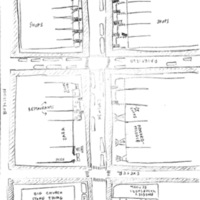
Copley Place and the Prudential Center make use of a lot of natural light let in by atrium- style ceilings and large windows. The white-accented walls reflect the natural light in a way that makes the entire mall seem bright, clean, and airy. The…
Daniel Montoya
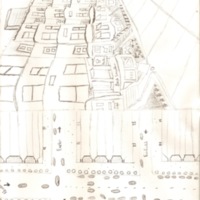
Beginning with the spatial analysis of the Prudential Mall, one can see the development of commerce in a unique geographic dimension. The first things you notice when entering this mall is the sheer magnitude and monumental size of both the stores…
Drisana Mosaphir
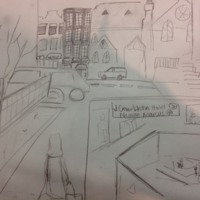
One feature of Copley Place that I found interesting was the instinct to mirror the layout of outdoor places. The signs that functioned almost as outdoor directional signs, as well as the fact that seating areas within the mall almost mirrored the…
Quinn Mulholland
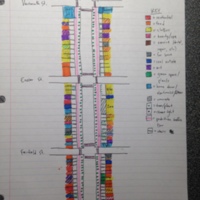
As I walked through Copley Place and the Prudential Center, I was struck by how the visual experience of the mall changed, both in terms of types of stores and in terms of aesthetics. Copley Place seemed to be mostly high-end fashion retailers, and…
Harry Newman-Plotnick

The main point I attempted to distinguish in these two/three drawings was the difference between non-commercial walkways in the two spaces. In the malls the walkways felt like these clearly defined pathways, with just a few entrances/exits,…
Adam Oh

Having visited both Newbury and Copley/Prudential shopping centers, I was most surprised by the difference of the vibes that these two places gave. In the Newbury’s shops/street, we notice that it has a more homey feeling due to the linear building…
Todd Preston
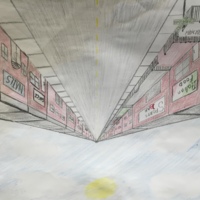
This assignment offers the chance to view two separate, but close, locations. They are both very unique from one another. While most may get lost in the Prudential/Copley shopping district, it would be very difficult to lose your way while traveling…
Daniel Prosky
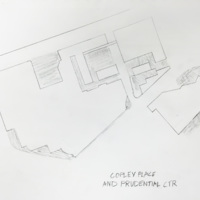
The two shopping areas are vastly different—the first, obvious difference is that Copley Place and the Prudential Center are indoor shopping malls, and Newbury Street is an outdoor street lined with individual shops. That being said, the traffic…