Jordan Canedy
Title
Jordan Canedy
Description
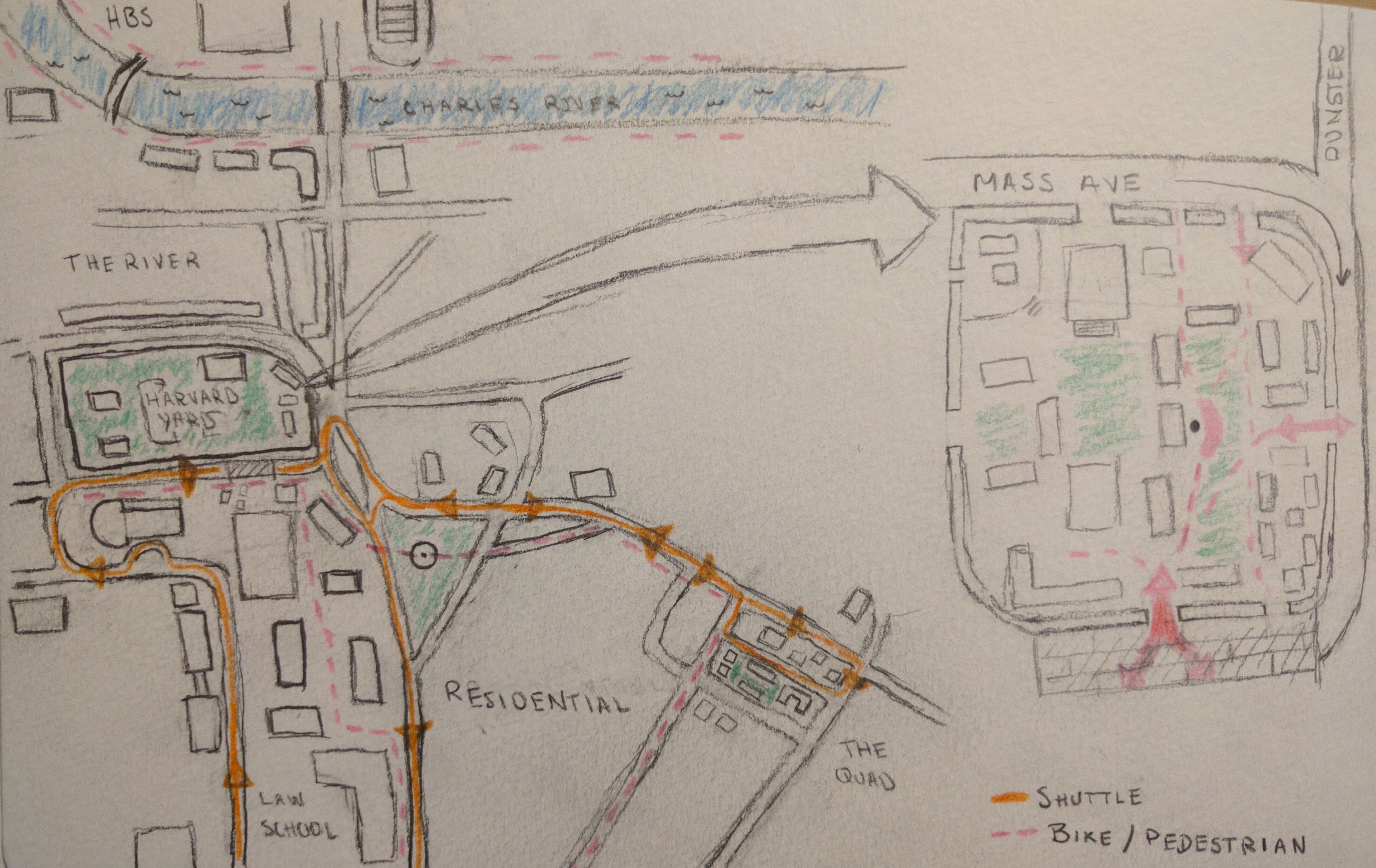
As a senior, I expected this sketchbook assignment to be relatively straightforward: a mapping of an area I feel relatively comfortable with. However, this sketchbook assignment really tested my knowledge of the Harvard Square area and helped me realize which features of the square stand out as important to me.
When I first started sketching my ideas of how the square looked, I initially started with the Radcliffe Quadrangle, which was unsurprising since I live and spend a majority of my time there. However, as I transitioned to other parts of the sketch, this “quadcentric” perspective clearly shaped my interpretation of the rest of the square. This is apparent when comparing my sketch to an actual map. My rendition of the square tends to be more accurate and larger for buildings in closer proximity to the quad and less so as the distance from the quad increases. This could suggest that our perception of space is in relation to our residential or living spaces.
Two other noteworthy conclusions can be drawn from my sketch of the square. The first is the choice of buildings that appear on my sketch. Mostly academic buildings, the buildings I use most frequently, appear instead of commercial buildings on the square. The second is the flow of people either taking shuttles or walking/biking between the quad and Harvard Yard. What stood out to me was that that pedestrians often traversed green spaces like the yard or Cambridge commons.
The key takeaway for me from this sketchbook assignment was that the information we most understand about our environments are contained in the activities and spaces we come into contact regularly.
When I first started sketching my ideas of how the square looked, I initially started with the Radcliffe Quadrangle, which was unsurprising since I live and spend a majority of my time there. However, as I transitioned to other parts of the sketch, this “quadcentric” perspective clearly shaped my interpretation of the rest of the square. This is apparent when comparing my sketch to an actual map. My rendition of the square tends to be more accurate and larger for buildings in closer proximity to the quad and less so as the distance from the quad increases. This could suggest that our perception of space is in relation to our residential or living spaces.
Two other noteworthy conclusions can be drawn from my sketch of the square. The first is the choice of buildings that appear on my sketch. Mostly academic buildings, the buildings I use most frequently, appear instead of commercial buildings on the square. The second is the flow of people either taking shuttles or walking/biking between the quad and Harvard Yard. What stood out to me was that that pedestrians often traversed green spaces like the yard or Cambridge commons.
The key takeaway for me from this sketchbook assignment was that the information we most understand about our environments are contained in the activities and spaces we come into contact regularly.
Files
Collection
Citation
“Jordan Canedy,” US-WORLD 29, accessed October 18, 2026, https://usworld29.omeka.fas.harvard.edu/items/show/9.