Ellen Poile
Title
Ellen Poile
Description
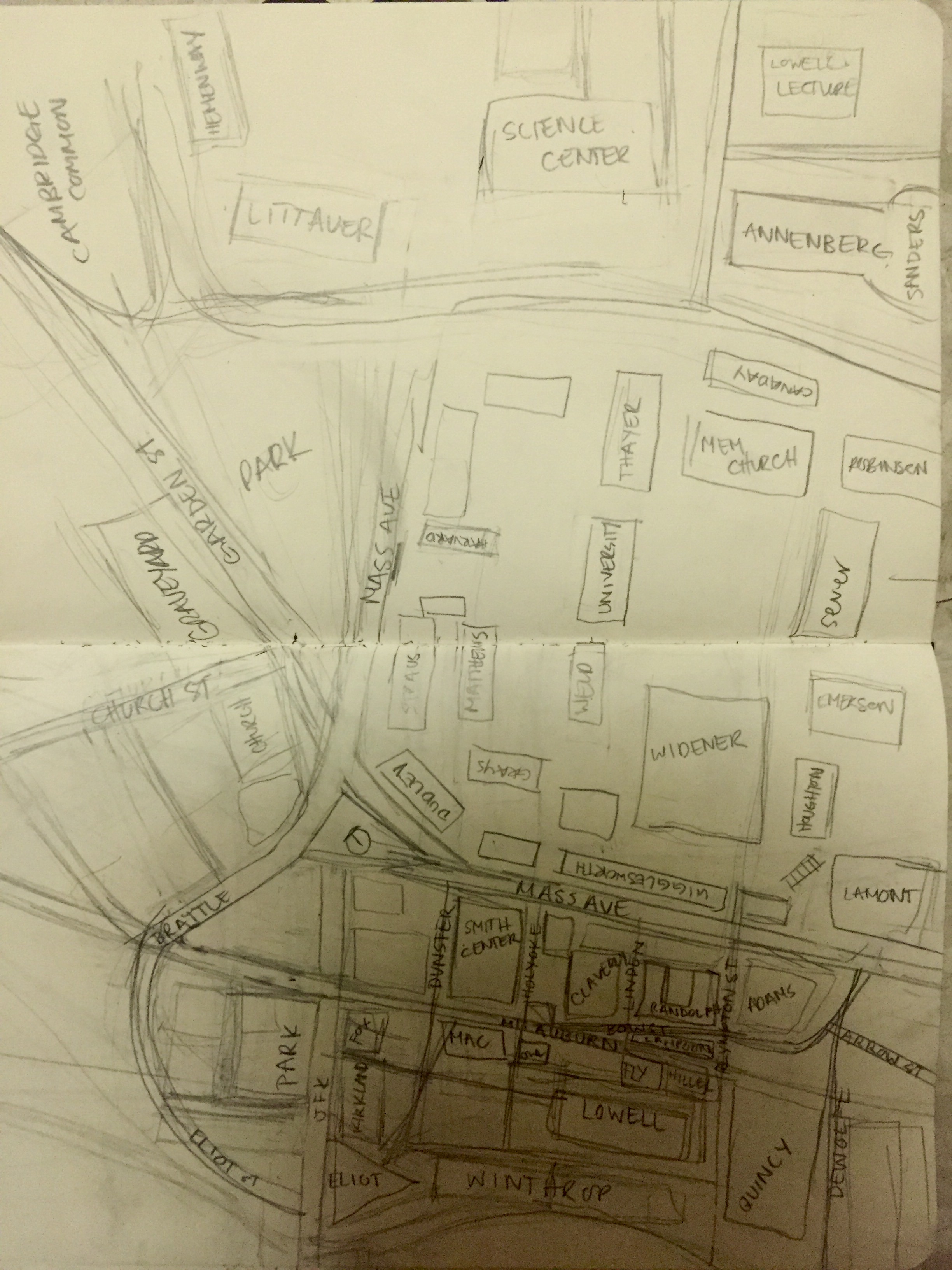
I found this exercise surprisingly difficult. Trying to layout my mental image of the square onto paper stumped me. First, I could not figure out how to orient Harvard Square onto the dimensions of my notebook paper. The question of fitting everything on the page with the proper scale left me grasping for the right size and direction of my landmarks. Not surprisingly, the yard occupies a much larger area than appropriate, as it was the easiest starting point. I knew how the buildings related to each other and I knew that it was generally a rectangle. This left me squeezing other parts onto too small areas of paper. However, even in the yard, I didn’t know the footprint or the number of certain dorms and buildings that I had never visited. In the bottom area of my map (between the yard and the river) I became overwhelmed in the details and number of features. As these blocks are where I live and spend most of my time, I knew the buildings and the streets the best. However, towards the river (down JFK) I do not spend as much time, so I became more confused. In fact, I ended up excluding an entire block and street between Mt. Auburn and Memorial Drive that consisted of buildings I do not use; I had simplified this area to only the houses. This led to a problem on the other side of JFK, where I knew there were commercial buildings and a park, yet I couldn’t make the streets match up. As a result, the scale on one side of JFK is different than the other. Interestingly, I found the streets the most difficult aspect of the map to draw. I remembered what buildings they led to and their names, but not their lengths and directions, particularly the streets that are not in a grid (such as Eliot St., Brattle St., Arrow St.). However, when I began my map, I instinctively began with the main streets. For my studies, this led me to zoom in on certain difficult areas to organize them, such as the intersection by the T and how the JFK and Mt. Auburn intersection (which I knew was a 90 degree intersection) related to the river. I discovered later that it was actually easier to place the buildings I knew in relation to each other and connect them with the appropriate streets. As I added more buildings, I realized how little space I had left. I had to erase and redraw many of my landmarks as smaller and re-angle my streets to fit everything. In the end, I was most surprised by what I had to omit. I knew I was missing things, such as Winthrop St, buildings in the yard, the streets leading to the quad, but I genuinely did not know what they were; I just sensed a lack. Things I had noticed and moved around but never used or named. I learned that after four years, I still do not know how to get to the Quad, so I left it out of my map.
Files
Collection
Citation
“Ellen Poile,” US-WORLD 29, accessed October 19, 2026, https://usworld29.omeka.fas.harvard.edu/items/show/53.