Daniel Montoya
Title
Daniel Montoya
Description
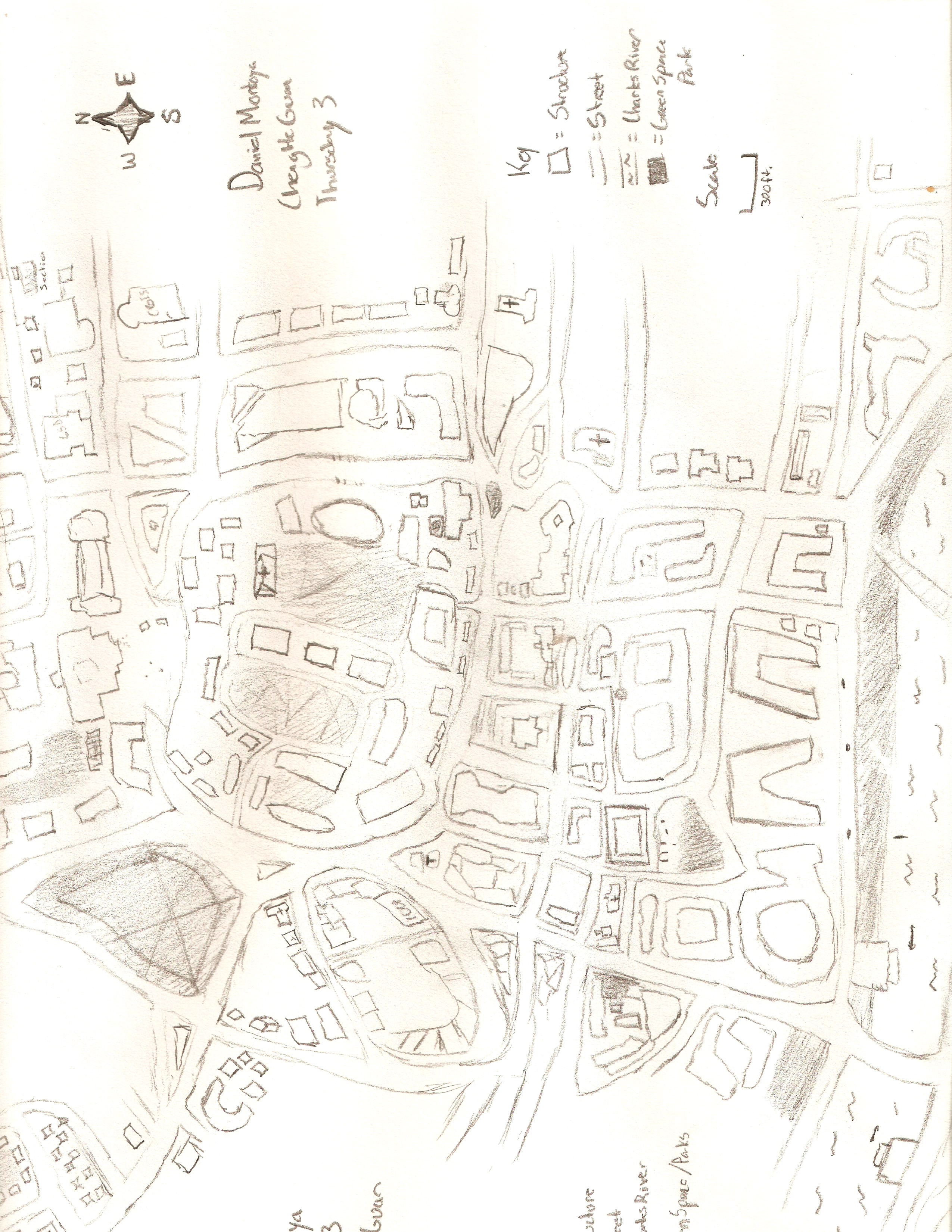
Urban design still remains a foreign concept: space, dimensions, structure can easily clutter the mind when drawing our fondest roads from memory. Despite the initial hesitation and frequent erasure marks, I believe the product that came out captured the spatial distribution of Harvard very closely. The map is not completely accurate, by no stretch of the imagination, but it really does encapsulate the most important landmarks of Harvard while respecting the spatial distribution of the urban/suburban settlement. Right off the back, the biggest difference I see is that of perception, meaning that in comparison to the actual map, my map elongates certain bottom portions. This is most apparent with Winthrop House which is my home, as well as the point of origin for the sketch. Winthrop is by no means the same size as the Science Center but the way I went about designing this map started from home and worked its way abroad causing certain levels of exaggeration in size for Winthrop (but not substantial). Furthermore, my map has very accurate points at times, the Yard, the walk to the Quad, the houses along the river symbolize places that matched up almost identically to the real map. This is most likely do to these places being centers of my life, and thus my memories that I can perfectly sketch them out. It seems that these three foci served as the triangle of urban planning for my mental map in which the great challenge was filling the in-between space and the peripheries with landmarks that I could easily recognize.
As compared to a flat map, my map makes use of height in buildings that are stereotypically tall for the rather low (five floors or below) heights of the buildings in the area. The way it became manifested in the map was in the form of visual stylizations where a level of three-dimensionality was added to buildings like Memorial Hall, Annenberg Hall, The Smith Campus Center, the Leveret Towers among others. As a final note, somewhere that the two maps do align is with the demarcation of parks, green with the Google Maps and shaded in with my map. Parks and green spaces are extremely important in these areas, particularly considering the masses of brick buildings that align the streets, so there is extra attention placed on them for this unique purpose.
As compared to a flat map, my map makes use of height in buildings that are stereotypically tall for the rather low (five floors or below) heights of the buildings in the area. The way it became manifested in the map was in the form of visual stylizations where a level of three-dimensionality was added to buildings like Memorial Hall, Annenberg Hall, The Smith Campus Center, the Leveret Towers among others. As a final note, somewhere that the two maps do align is with the demarcation of parks, green with the Google Maps and shaded in with my map. Parks and green spaces are extremely important in these areas, particularly considering the masses of brick buildings that align the streets, so there is extra attention placed on them for this unique purpose.
Files
Collection
Citation
“Daniel Montoya,” US-WORLD 29, accessed October 19, 2026, https://usworld29.omeka.fas.harvard.edu/items/show/48.