Anja Moser
Title
Anja Moser
Description
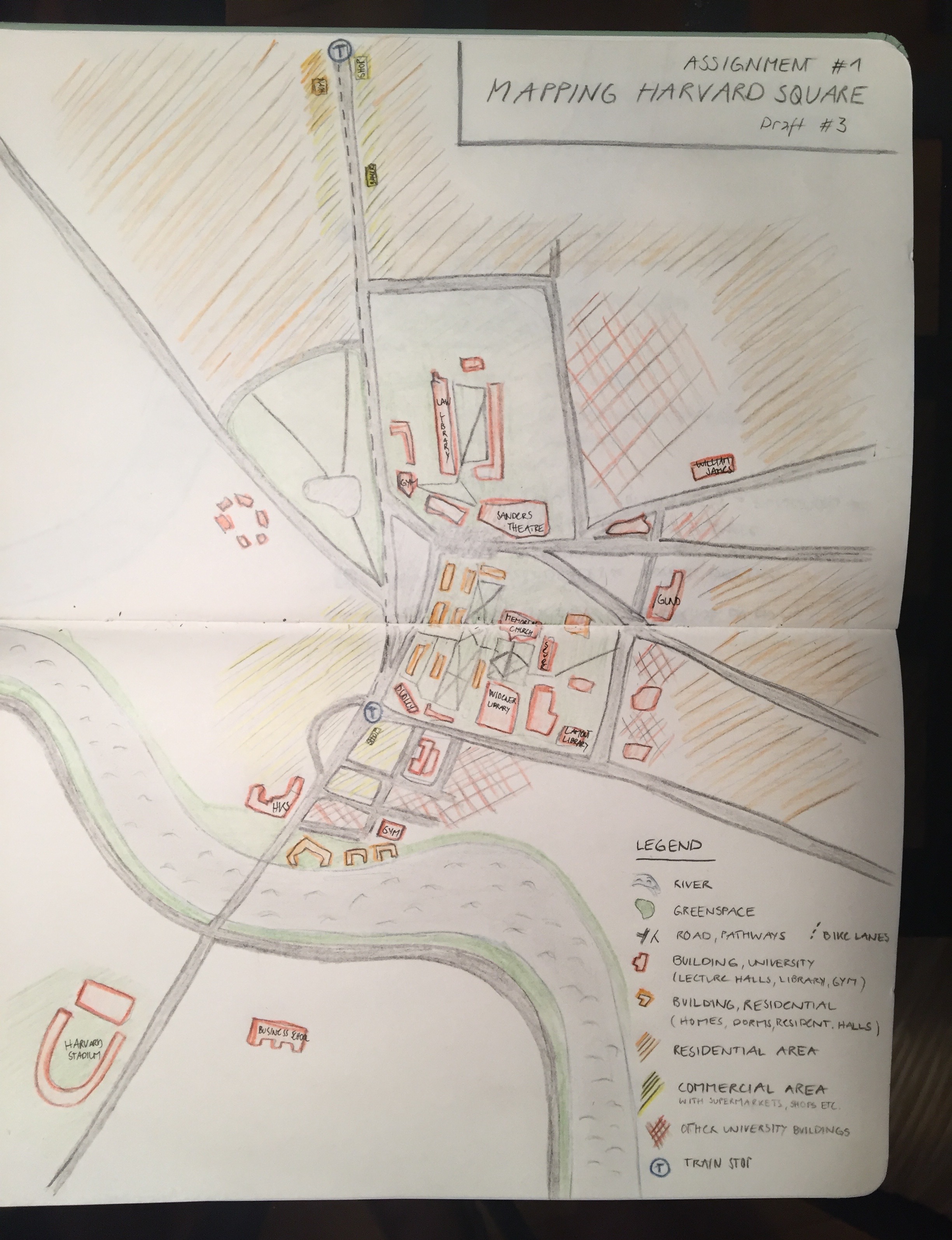
Comparing the sketch I drew from memory for this assignment to a map I bought when I arrived here in Cambridge three weeks ago, it stroke me that there were vast areas on the campus and in the city I did not know – let alone how they looked like. Whereas I was able to measure distances quite accurately - I believe this is thanks to my daily commute either on my bicycle or by foot - I was not able to sketch a “complete” map of Harvard Square and surrounding. Rather, I realized that my sketch only features the environment I interact with on a daily basis such as the buildings I have courses in, my local bakery or green spaces I use to go for a run – short, the sketch only featured what is important for me as an individual to be able to interact with the city and to get around in it.
Furthermore, in contrast to the map I bought, I structured my sketch in commercial, residential and green areas – again a help for me to get around. Whereas the map only showed streets and houses and made no distinctions between different uses of the buildings and streets, my sketch allowed me to locate shops, private homes or University property and even bike lanes on the streets.
In my opinion these differences between my sketch and the map stem from the following reasoning: maps are a highly simplified reflection of reality. By reducing complexity to one specific layer of a city – such as the street system and adjacent housing in the example of the map I bought – they allow their users to be able to orient themselves and find what they are looking for. However in order to be able to do so maps only show one aspect of the complex reality. If we for example included a heat map on top of the street map it would definitely serve the homeless person to find what he is looking for (a warm shelter) – however it would confuse the car driver looking for a specific street. Each map hence serves its own purpose. Therefore, I believe my sketch is different from the map I bought because it represents the layers important to me personally (green spaces, university buildings, roads were I bike etc.) – or put it differently because it represents my view of reality and how I relate to and interact with the city I now live in.
Furthermore, in contrast to the map I bought, I structured my sketch in commercial, residential and green areas – again a help for me to get around. Whereas the map only showed streets and houses and made no distinctions between different uses of the buildings and streets, my sketch allowed me to locate shops, private homes or University property and even bike lanes on the streets.
In my opinion these differences between my sketch and the map stem from the following reasoning: maps are a highly simplified reflection of reality. By reducing complexity to one specific layer of a city – such as the street system and adjacent housing in the example of the map I bought – they allow their users to be able to orient themselves and find what they are looking for. However in order to be able to do so maps only show one aspect of the complex reality. If we for example included a heat map on top of the street map it would definitely serve the homeless person to find what he is looking for (a warm shelter) – however it would confuse the car driver looking for a specific street. Each map hence serves its own purpose. Therefore, I believe my sketch is different from the map I bought because it represents the layers important to me personally (green spaces, university buildings, roads were I bike etc.) – or put it differently because it represents my view of reality and how I relate to and interact with the city I now live in.
Files
Collection
Citation
“Anja Moser,” US-WORLD 29, accessed October 18, 2026, https://usworld29.omeka.fas.harvard.edu/items/show/201.