Sarah Zaghouani
Title
Sarah Zaghouani
Description
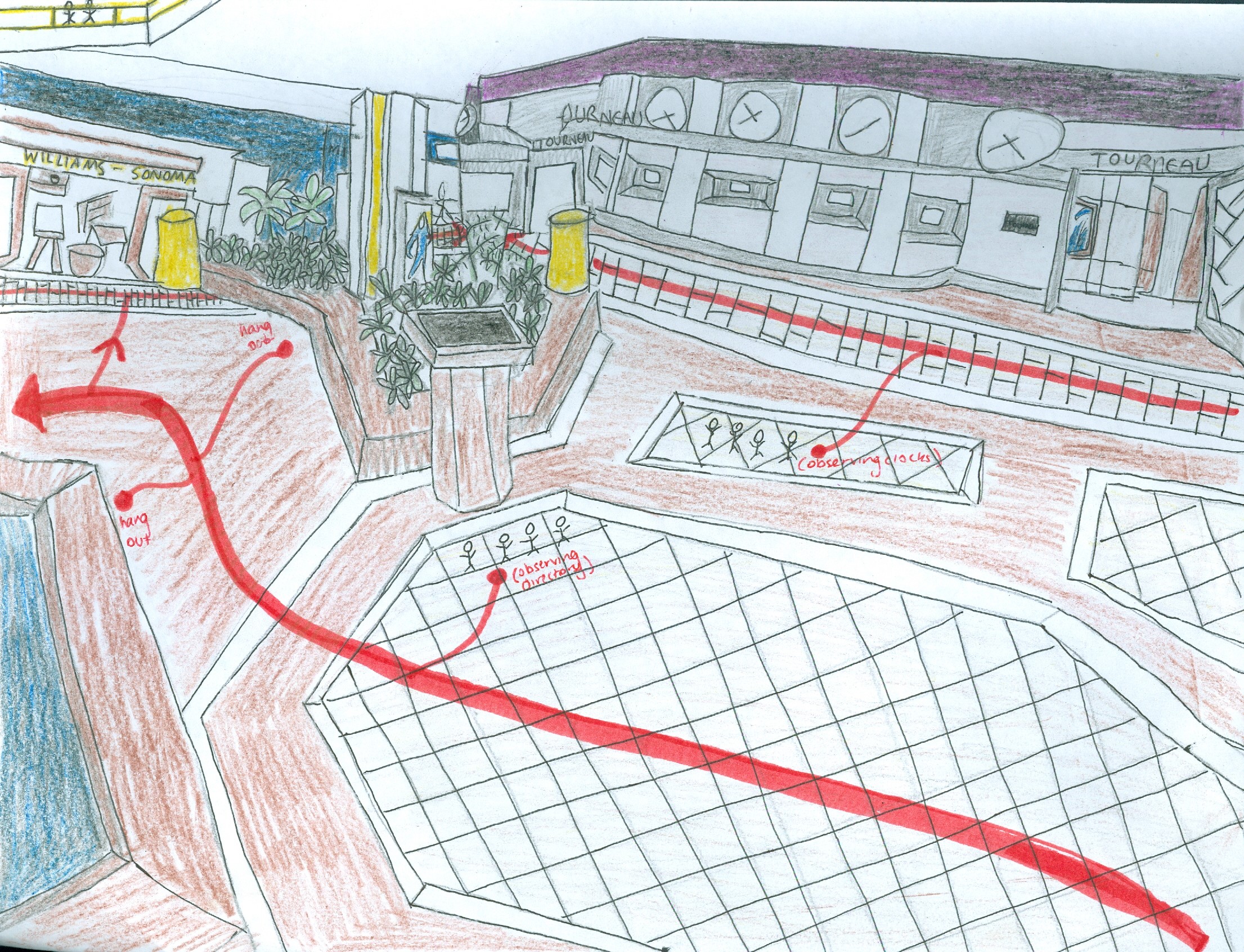
Prudential (and Copley, to a lesser degree) attempts to replicate the experience of outdoor shopping/leisure—but in a sheltered environment. Prudential lets in a LOT of light. There is a preponderance of indoor greenery, ironically concentrated in the Huntington Arcade, which consists largely of banks and investment centers. Additionally, 101 Huntington Avenue, though it faces indoors, has a brick façade, much like one you would find on a public street, again giving the illusion of outdoor shopping. When one enters the walkway to cross into Copley, the walls are entirely transparent, and you can see that you are walking right over a major road intersection—giving you the feeling of being immersed in the city, while protected from the hustle and bustle. Additionally, at both the Shops at Prudential and at Copley Place, upon entering the buildings, you have to travel pretty high up on an escalator in order to reach the retail level. This immediately transplants you from the action happening on the urban streets at ground level to a more enclosed, peaceful, almost suburban community—where whatever you need, be it food, clothing, watch repair, the gym, or the bank—is all located in one covered, climate-controlled space and is easily accessible. At the same time, signage orienting you toward such Boston landmarks as the Hynes Convention Center, the Copley Mariott, or various iconic streets, all connected by the Prudential Center, is a reminder that you are still in the city. Additionally, like on city sidewalks, there are a number of benches lined along each arcade for people watchers and tired shoppers. Therefore, what is unique about the Prudential Center is that you find a suburban venue of respite in the midst of the city.
Copley, while additionally an enclosed shopping mall that aims for integration into the outdoors, gives the feel of a much more rigid, high-end shopping experience. When you take the escalator up into the shopping area, immediately, the first store you see is Tiffany and Co. or Louis Vuitton, setting the tone for the rest of the shopping experience, and clearly indicating who has business shopping at Copley and who does not. or While the floors of the Prudential Center consist entirely of light-colored faux marble that invites one to wander around any which way, Copley is characterized by rich reddish marble with distinct borders and cobblestone-like demarcations that work together to lay out walking paths. Many elements of Copley’s interior design are gilded, and there is a noticeably warm, rich color theme. Besides the narrower walking paths, Copley also features lower ceilings and fewer places to sit than Prudential, suggesting a preference that shoppers actually shop instead of dilly-dallying. At the Central Court, however, which features a very high transparent ceiling, there is a return to emulation of the outdoors with an abundance of natural light and a ton of greenery, as well as a giant earth-toned abstract sculpture.
Both Prudential and Copley integrate stores with unique, brand-specific storefronts into a singular building with a relatively cohesive design, giving both venues a more suburban feel. Additionally, both are anchored by large department stores: Saks Fifth Avenue, Neiman Marcus, Lord & Taylor. Larger entrances/facades and mini store-specific atria distinguish these anchors from other stores. Additionally, they are all found at different poles of the enclosure, so that shoppers end up passing through large portions of the mall to arrive at each. When a shopper enters a branch that contains one of these large department stores, the shopper can see the store all the way at the end of the branch, which is typically quite large.
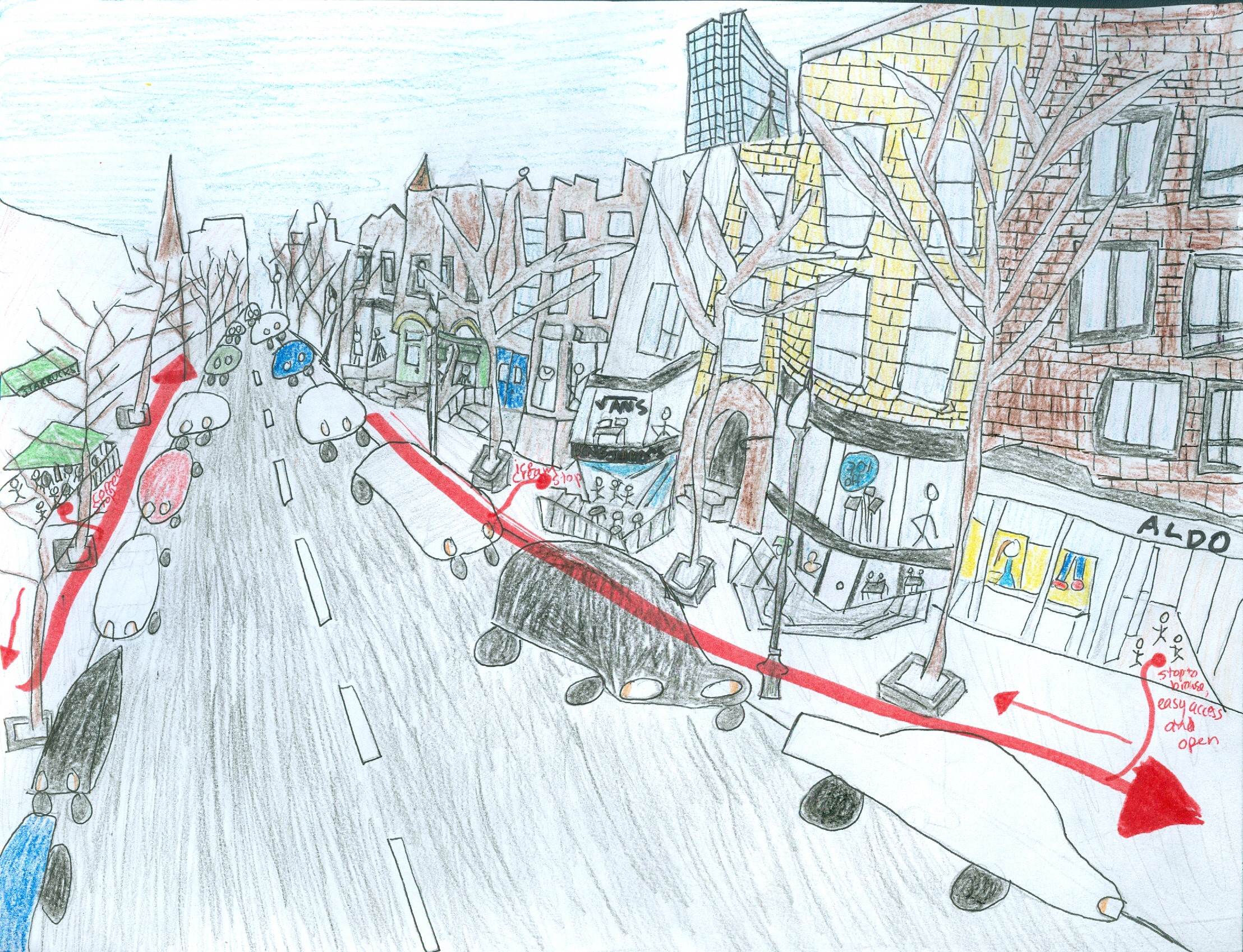
In the case of Newbury Street, it is immediately apparent that the space is commercial, as nearly the entire street is lined by window displays of clothing, shoes, accessories, what have you. At street intersections, there tends to be more sidewalk space, and lots of outdoor seating provided by cafes and restaurants, and so individual retailers and buskers often set up shop in that area. Like Prudential, Copley, and other enclosed shopping spaces, Newbury St. is also anchored, but not by department stores: rather, by Boston Public Garden at one end, and Massachusetts Avenue on the other end. There is no branching around a central arcade, in contrast to Prudential/Copley, rendering shopping at Newbury more inconvenient. It is interesting to note, however, that shoppers can plan accordingly if they observe that the most high-end stores are located at the Boston Public Garden end of Newbury St., and gradually become edgier/more urban as one approaches Mass. Ave. Additionally, though malls make for quicker navigation, at both malls and a setup like Newbury, visibility of shops ahead is greatly obscured, whether by turns at indoor malls, or by the trees that line Newbury. Therefore, there is the impetus to continue to walk and pass by stores in order to discover new stores.
Another observable similarity between Newbury and the enclosed mall is the unique storefronts blended into a cohesive design; in the case of Newbury, this is largely 19th century brownstone. That cohesion deviates occasionally, as is illustrated in my sketch of Newbury, but quickly returns to a series of brownstone facades. It is interesting to note that larger, more well-known stores have extra sidewalk space and notably large, unique facades, much like the department stores in enclosed malls.
An additional feature of enclosed malls that we mentioned, the element of almost suburban isolation, is also seen on Newbury. Compared to surrounding streets, Newbury feels quieter and more isolated from the hectic nature of urban life. Sidewalk spaces are bigger, and the space allotted to cars is narrower, placing greater importance on the strolling pedestrian. Additionally, the tall skyscrapers of the Back Bay area are largely hidden from view, peaking out occasionally. That, combined with the blending of Newbury St buildings into other residential buildings, especially toward the Charles River, gives the street a very suburban feel. There are also restaurants/cafes interspersed with shops, providing similar convenience to that of the mall, though there is a notable absence of other connected features that make Prudential and Copley so convenient, like banks, gyms, etc. Additionally, while enclosed malls have two or three discrete levels, on which all stores are located at ground level, adjacent shops on Newbury could be at, under, or above ground, reducing accessibility greatly. I came to realize that this is why I saw the most business at ground-level stores on Newbury—they are more easily accessible; this facilitates simply wandering it to have a look. Adding stairs makes a shopping trip more purposeful, and so I would guess that shoppers on Newbury tend to shop more decisively than Prudential shoppers.
On Newbury, there is more of a strict emphasis on shopping and eating. As opposed to benches on the sidewalks, all sitting areas belong to some café or restaurant, encouraging eating for leisure. In enclosed malls, there are other places for people to hang out—benches, arcades, but often people are holding a drink in a Styrofoam cup or a take-out box—food for pleasure is not really a focus of the in-mall shopping experience. Exits from Newbury are located at street intersections, and differ based on which direction one takes. Exiting Newbury in the direction of the Charles River lands one in exclusively residential areas, while heading toward Copley gradually adds the hustle and bustle of urban life back into the scene. Newbury St. is perfectly situated at the crossroads of both scenes.
Copley, while additionally an enclosed shopping mall that aims for integration into the outdoors, gives the feel of a much more rigid, high-end shopping experience. When you take the escalator up into the shopping area, immediately, the first store you see is Tiffany and Co. or Louis Vuitton, setting the tone for the rest of the shopping experience, and clearly indicating who has business shopping at Copley and who does not. or While the floors of the Prudential Center consist entirely of light-colored faux marble that invites one to wander around any which way, Copley is characterized by rich reddish marble with distinct borders and cobblestone-like demarcations that work together to lay out walking paths. Many elements of Copley’s interior design are gilded, and there is a noticeably warm, rich color theme. Besides the narrower walking paths, Copley also features lower ceilings and fewer places to sit than Prudential, suggesting a preference that shoppers actually shop instead of dilly-dallying. At the Central Court, however, which features a very high transparent ceiling, there is a return to emulation of the outdoors with an abundance of natural light and a ton of greenery, as well as a giant earth-toned abstract sculpture.
Both Prudential and Copley integrate stores with unique, brand-specific storefronts into a singular building with a relatively cohesive design, giving both venues a more suburban feel. Additionally, both are anchored by large department stores: Saks Fifth Avenue, Neiman Marcus, Lord & Taylor. Larger entrances/facades and mini store-specific atria distinguish these anchors from other stores. Additionally, they are all found at different poles of the enclosure, so that shoppers end up passing through large portions of the mall to arrive at each. When a shopper enters a branch that contains one of these large department stores, the shopper can see the store all the way at the end of the branch, which is typically quite large.
In the case of Newbury Street, it is immediately apparent that the space is commercial, as nearly the entire street is lined by window displays of clothing, shoes, accessories, what have you. At street intersections, there tends to be more sidewalk space, and lots of outdoor seating provided by cafes and restaurants, and so individual retailers and buskers often set up shop in that area. Like Prudential, Copley, and other enclosed shopping spaces, Newbury St. is also anchored, but not by department stores: rather, by Boston Public Garden at one end, and Massachusetts Avenue on the other end. There is no branching around a central arcade, in contrast to Prudential/Copley, rendering shopping at Newbury more inconvenient. It is interesting to note, however, that shoppers can plan accordingly if they observe that the most high-end stores are located at the Boston Public Garden end of Newbury St., and gradually become edgier/more urban as one approaches Mass. Ave. Additionally, though malls make for quicker navigation, at both malls and a setup like Newbury, visibility of shops ahead is greatly obscured, whether by turns at indoor malls, or by the trees that line Newbury. Therefore, there is the impetus to continue to walk and pass by stores in order to discover new stores.
Another observable similarity between Newbury and the enclosed mall is the unique storefronts blended into a cohesive design; in the case of Newbury, this is largely 19th century brownstone. That cohesion deviates occasionally, as is illustrated in my sketch of Newbury, but quickly returns to a series of brownstone facades. It is interesting to note that larger, more well-known stores have extra sidewalk space and notably large, unique facades, much like the department stores in enclosed malls.
An additional feature of enclosed malls that we mentioned, the element of almost suburban isolation, is also seen on Newbury. Compared to surrounding streets, Newbury feels quieter and more isolated from the hectic nature of urban life. Sidewalk spaces are bigger, and the space allotted to cars is narrower, placing greater importance on the strolling pedestrian. Additionally, the tall skyscrapers of the Back Bay area are largely hidden from view, peaking out occasionally. That, combined with the blending of Newbury St buildings into other residential buildings, especially toward the Charles River, gives the street a very suburban feel. There are also restaurants/cafes interspersed with shops, providing similar convenience to that of the mall, though there is a notable absence of other connected features that make Prudential and Copley so convenient, like banks, gyms, etc. Additionally, while enclosed malls have two or three discrete levels, on which all stores are located at ground level, adjacent shops on Newbury could be at, under, or above ground, reducing accessibility greatly. I came to realize that this is why I saw the most business at ground-level stores on Newbury—they are more easily accessible; this facilitates simply wandering it to have a look. Adding stairs makes a shopping trip more purposeful, and so I would guess that shoppers on Newbury tend to shop more decisively than Prudential shoppers.
On Newbury, there is more of a strict emphasis on shopping and eating. As opposed to benches on the sidewalks, all sitting areas belong to some café or restaurant, encouraging eating for leisure. In enclosed malls, there are other places for people to hang out—benches, arcades, but often people are holding a drink in a Styrofoam cup or a take-out box—food for pleasure is not really a focus of the in-mall shopping experience. Exits from Newbury are located at street intersections, and differ based on which direction one takes. Exiting Newbury in the direction of the Charles River lands one in exclusively residential areas, while heading toward Copley gradually adds the hustle and bustle of urban life back into the scene. Newbury St. is perfectly situated at the crossroads of both scenes.
Files
Collection
Citation
“Sarah Zaghouani,” US-WORLD 29, accessed October 19, 2026, https://usworld29.omeka.fas.harvard.edu/items/show/171.