Sonja Eliason
Title
Sonja Eliason
Description
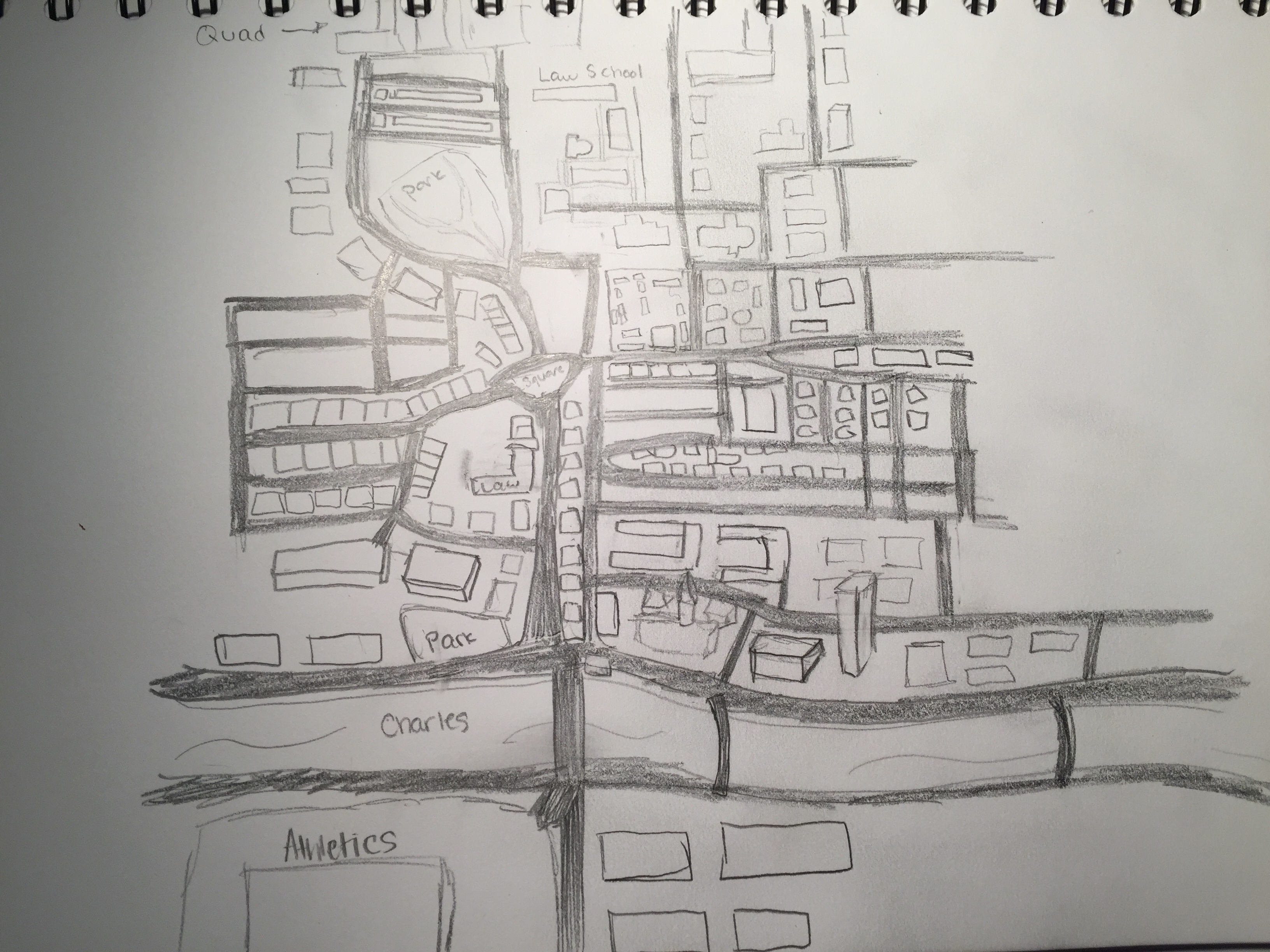
Looking at a map after attempting to sketch Harvard, I realize that Cambridge is not at all the grid system I ended up drawing. Trying to visualize Cambridge in my mind led to a very organized structure, but looking at a map shows all the curves and edges and somewhat sprawling nature of the city. Cambridge is definitely not the kind of grid that Jefferson would have designed, but conceptualizing a grid is much easier than the disorganized reality. Maybe this suggests something about the grid system and its appeal to people’s desire to have an orderly conception of their city, a certain predictability that makes it easier to manage. Perhaps it also says something about people’s search for patterns and their own perception of a city with which they are familiar.
I definitely underestimated the size of Harvard Yard and overestimated the size of the park. It’s possible that my perception of size was affected by the relative importance of certain places in my day-to-day life, or what I prioritized. The places I had the most trouble visualizing were those that I didn’t frequent or that were unrelated to Harvard. I knew if specific sections were residential or storefronts, and having that organized within the city was helpful, but if I didn’t frequent the area I had no idea how to conceptualize specifics.
If I were to redo my sketch, I think I would start with making the large geometric centers of Cambridge, and then fill in around them, since that is the way the city appears to be organized. The Yard is a large square, then there’s the large triangle of the park, and the smaller triangle of Brattle Square. If I had started with organizing those first, I think I would have had an easier time; my mistake was trying to draw streets and connections without giving myself easy landmarks, so nothing is in correct proportions. The streets all seem to move out in a fan formation from the intersection of those three major geometric locations, so I could have more easily produced the city from starting at the center and then moving progressively outwards. It’s very difficult to conceptualize a bird’s-eye-view of a city that I am used to seeing only from walking.
I definitely underestimated the size of Harvard Yard and overestimated the size of the park. It’s possible that my perception of size was affected by the relative importance of certain places in my day-to-day life, or what I prioritized. The places I had the most trouble visualizing were those that I didn’t frequent or that were unrelated to Harvard. I knew if specific sections were residential or storefronts, and having that organized within the city was helpful, but if I didn’t frequent the area I had no idea how to conceptualize specifics.
If I were to redo my sketch, I think I would start with making the large geometric centers of Cambridge, and then fill in around them, since that is the way the city appears to be organized. The Yard is a large square, then there’s the large triangle of the park, and the smaller triangle of Brattle Square. If I had started with organizing those first, I think I would have had an easier time; my mistake was trying to draw streets and connections without giving myself easy landmarks, so nothing is in correct proportions. The streets all seem to move out in a fan formation from the intersection of those three major geometric locations, so I could have more easily produced the city from starting at the center and then moving progressively outwards. It’s very difficult to conceptualize a bird’s-eye-view of a city that I am used to seeing only from walking.
Files
Collection
Citation
“Sonja Eliason,” US-WORLD 29, accessed October 19, 2026, https://usworld29.omeka.fas.harvard.edu/items/show/17.