John Griffin
Title
John Griffin
Description
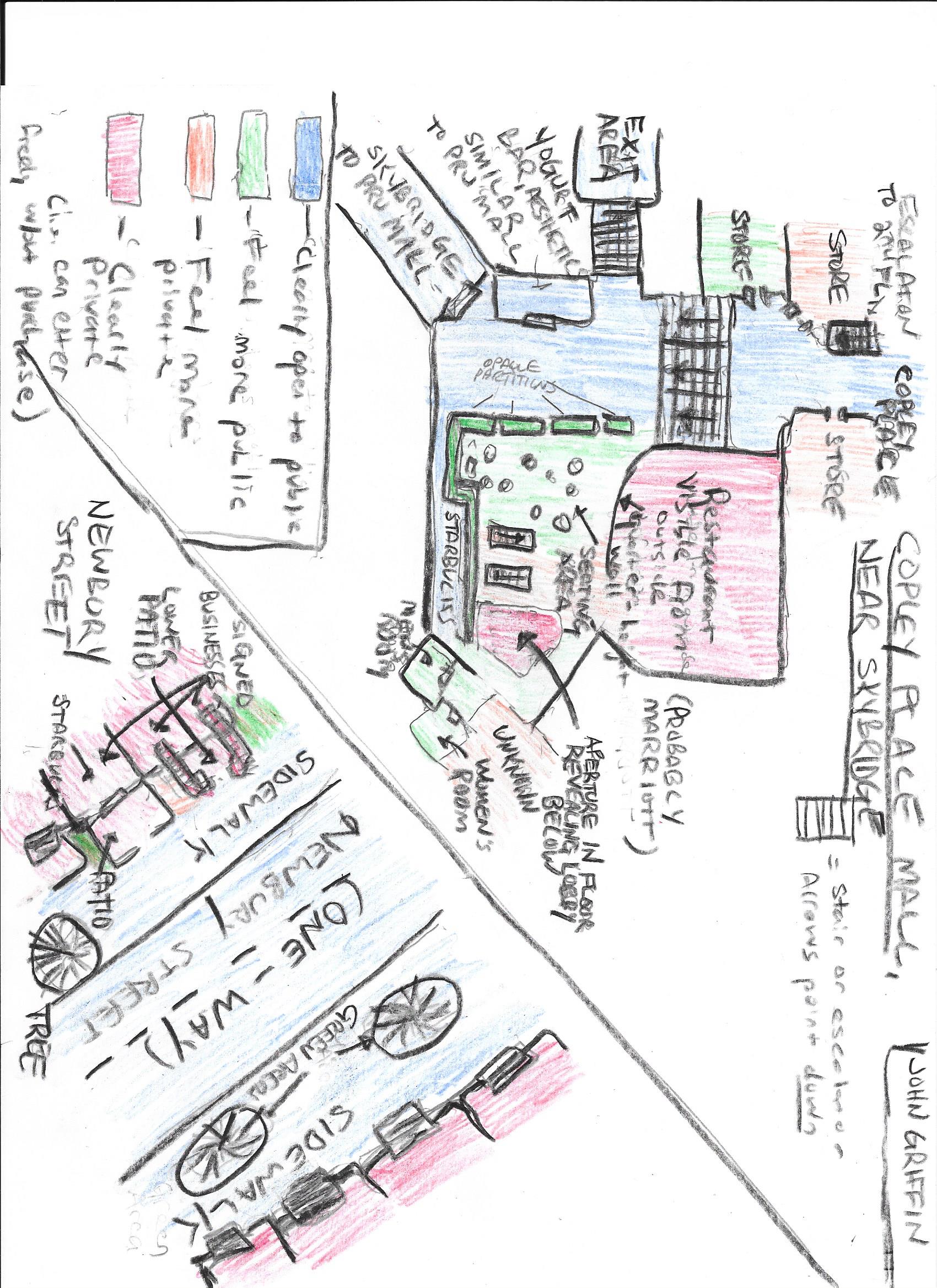
I was interested both in how this space in the mall complex seemed to function as a segue between the two malls and in how it delineated public vs. non-public spaces. In regards to the first point, I noticed that the two malls had very different "feels." Copley Place was muted in color (lots of beiges and browns) and sound (materials didn't cause a lot of echo and there were less people in general). It also tended to feel like Copley Place had pretty "definite" boundaries as to where mallgoers could enter if they did not intend to buy something--there were stern-looking people standing in the doorways of many stores. There were also few windows or doors into the outside world that were not "below" mallgoers, accessible only by stairs. In the Pru Mall, by contrast, the colors were brighter, the materials caused lots of echo, there were many more people, and the floor-plan seemed more convoluted. It also had higher ceilings and several arcades lined on one side by brick walls and on the other by glass, giving the impression that one was "outside." In this intermediate section, the colors were muted but not earth tones (as in Copley Place); there were high ceilings and many windows, but most of them were at least somewhat opaque; and the sound echoed, but was fairly dispersed. This section also seemed to serve as an intermediary between Copley Place's stricter delineation of public and non-public spaces and the general openness of the Prudential Center. One example of this that confused me at first is the seating area outside the Marriott lobby. The area is open to the public, but bound on three sides by areas that are not (a Marriott-affiliated restaurant, stairways to the Marriott lobby, and an aperture in the floor that overlooks the lobby itself). Its fourth side abuts the main public walkway, but is set off by opaque green panels. The area is darker than the mall walkway and contains stern-looking attendants. Apparently as a result of these features, mallgoers seemed tentative to enter this space; most of those who did appeared to be well-dressed businessmen. Because I found this public/private delineation so interesting in the mall, I also paid attention to it on Newbury Street. I found there that on one side of the street, the buildings were mostly unmarked (and apparently residential). On that side, there is a pretty clear delineation between public and private space: the sidewalk is public and the buildings are private. On the other side, where there are more commercial buildings, the distinction is less clear. Many of these shops and restaurants have patio space jutting out into the public sidewalk; while these spaces seem meant to invite people into the business, they also seem the opposite of inviting to non-customers. There are also spaces between these patios that are ostensibly open to the public, but people did not seem to venture into those spaces.
Files
Collection
Citation
“John Griffin,” US-WORLD 29, accessed October 19, 2026, https://usworld29.omeka.fas.harvard.edu/items/show/113.